IOCCG news bulletins include items of interest from the IOCCG, its sponsoring agencies, and the broader ocean colour community. Please let us know if there are any items of interest you would like to see in the next IOCCG news bulletin by contacting Raisha Lovindeer (raisha@ioccg.org). IOCCG is now on Bluesky! Check it out or follow us for more frequent updates.
News from IOCCG
Report on the Proceedings of IOCS-2025 Now Available
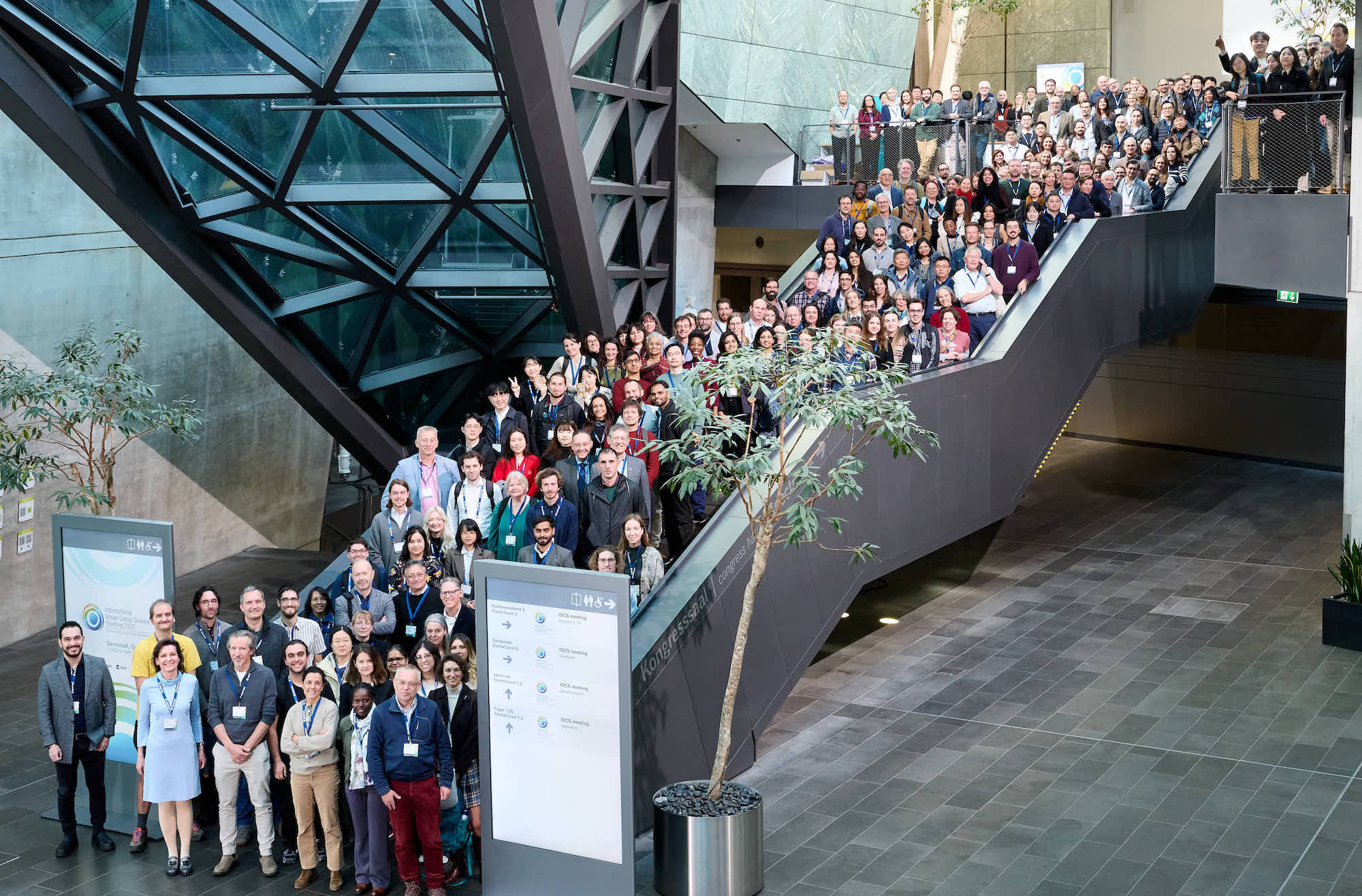
IOCS-2025 Meeting was held in Darmstadt, Germany from 1-4 December 2025. A big thank you to all the community members who attended the meeting, or streamed online, as well as to the hosts EUMETSAT and ESA, with support from the European Commission.
The Proceeding of IOCS-2025 report, with descriptions of all the sessions, including recommendations from the breakout sessions, is now available on the archive webpage at iocs.ioccg.org/iocs-2025-meeting. Also available are slides from plenary presentations, reports from the breakout sessions, and the Book of Poster Abstracts from the meeting.
IOCCG Report 21: Evaluation of Atmospheric Correction Algorithms over Turbid Waters
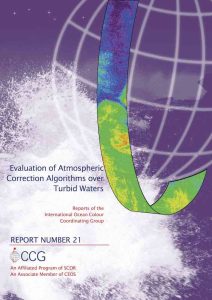 IOCCG Report 21 on Evaluation of Atmospheric Correction Algorithms over Turbid Waters (edited by Cédric Jamet and Sundarabalan V. Balasubramanian) was published in 2025 by the IOCCG Working Group on the Intercomparison of Atmospheric Correction Algorithms over Optically-Complex Waters. Report 21 evaluates ten atmospheric correction algorithms using in-situ measurements and a simulated dataset applied to data from MODIS-Aqua, and ranks the performance of these algorithms based on optical water types, from clear to moderately turbid waters.
The report is currently available from the IOCCG website at ioccg.org/ioccg-reports. It will be available from the IOC Ocean Best Practices Repository once their website and interface upgrades have been completed and submissions reopen.
IOCCG Report: Benthic Reflectance Measurements for Aquatic Applications open for interactive peer review until 20 March 2026
 A draft version of the IOCCG report Benthic reflectance measurements for aquatic applications is now available on the IOCCG website for interactive community feedback for a period of 60 days, with a closing deadline for comments of 20 March 2026. During the interactive review period, members of the community are invited to leave comments directly on the draft report, and authors may respond as they are received and make tracked-changed edits that are visible to all.
The report is an output from the IOCCG Working Group on Conducting Benthic Reflectance Measurements. It introduces benthic reflectance and provides methods and example spectra for aquatic benthic environments, from shallow water to the deep sea.
Link: IOCCG DRAFT Report: Benthic reflectance measurements for aquatic applications
Announcing the 2026 IOCCG Platt Scholarship Award
The IOCCG is delighted to announce the 2026 award winner of the IOCCG Platt Scholarship: B Goutami.

B Goutami (XIM University, India) will work with Gemma Kulk (PML, UK) on research on Satellite-Based Assessment of Phytoplankton Phenology as an Indicator of Ecosystem Resilience in Coastal and Estuarine Environments. She is a PhD Scholar at the School of Sustainability with experience working on coastal wetlands, focusing on understanding coastal wetland resilience in the Indian Peninsula in response to both increasing anthropogenic and climatic stressors. She is working towards quantitative and qualitative assessments of coastal wetlands and developing algorithms for various water quality parameters, including chlorophyll a, in these areas in India, and is looking to strengthen the institutional capacity in ocean colour remote sensing through collaboration with PML. She plans to integrate the knowledge gained through her research exchange into various core courses at her university and other connected institutions at both undergraduate and graduate levels, and she has the requisite teaching experience for this task.
Congratulations B Goutami! We look forward to seeing the results of your research exchange.
Applications now OPEN for 2026 IOCCG Summer Lecture Series: Venice, Italy, 5 – 19 July
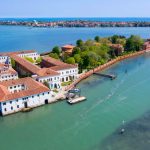 Applications are open for the 7th IOCCG Summer Lecture Series (SLS), scheduled for 5 – 19 July 2026, hosted by CNR-ISMAR and the Venice International University (VIU) in Venice, Italy. The SLS will be held at the VIU campus on the island of San Servolo in the Venetian lagoon.
Applications for the 2026 SLS close on 15 February 2026. See the Summer Lecture Series webpage for details.
First Multi-Sensor Ocean Colour (MSOC) Course takes place post IOCS-2025
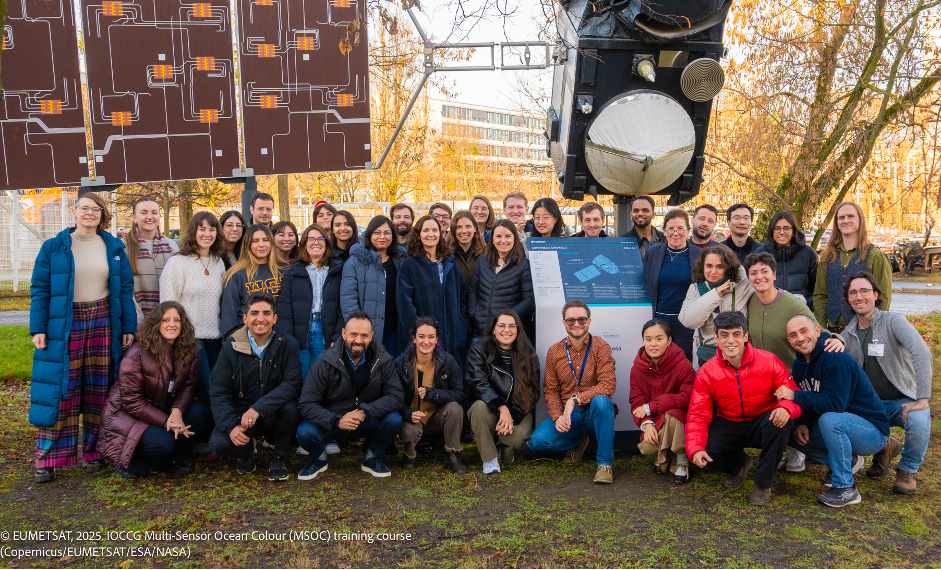
A new training course, organised by EUMETSAT in collaboration with NASA, ESA, and IOCCG, was held at EUMETSAT HQ post the 2025 IOCS meeting. The course provided advanced training on satellite ocean colour, with participants gaining both theoretical knowledge and practical experience of working with data from Copernicus Sentinel-3 and Sentinel-2, PACE, as well as downstream merged products from the Copernicus Marine Service. Participants learned about data access, atmospheric correction, algorithm development, calibration and validation, and the making of multi-sensor products. In small groups they were given a focus region of interest, where they practically implemented the knowledge gained to reflect on the utility of the different missions for a variety of applications. Each group gave a final presentation, showing what they had learned and how they hoped to use this in their future work. EUMETSAT would like to thank all the contributing trainers and the IOCCG and Copernicus programme for supporting participants to attend. Training material from the course will be uploaded to classroom.eumetsat.int, with links accessible from the IOCCG website training page: ioccg.org/what-we-do/training-and-education/lectures.
News from ESA & EUMETSAT
9th Sentinel-3 Validation Team meeting, 30 March – 1 April, 2026
The 9th Sentinel-3 Validation Team (S3VT) meeting will be hosted by ESA, co-chaired with EUMETSAT, and will take place from 30 March to 1 April 2026 at ESRIN, Frascati, Italy. The team looks forward to continuing their stimulating discussions on the scientific validation and potential improvements of the operational products from the Sentinel-3A and Sentinel-3B constellation, and to preparing for the future Cal/Val activities of the newest family member, Sentinel-3C. Abstract submission is now closed but attendance is still very welcome.
News from EUMETSAT
New Sentinel-3 OLCI level 2 Water processing in operations from 26 February 2026
EUMETSAT Sentinel-3 OLCI Level-2 Water processing and products will be updated in the operational processing, and named L2 Collection 4. The switch will occur on 26 February 2026. Changes in L2 product formatting and definition will affect all users, and current tools may stop working.
A summary of Collection 4 changes and access to the test datasets are available from the EUMETSAT News and Events User Portal.
Please contact EUMETSAT if you’re interested in supporting verification and validation of the new processing. After corresponding revisions, EUMETSAT will reprocess the full OLCI-A and OLCI-B L2 mission time series.
News from KIOST
Call for submission to Special Issue on Geostationary Ocean Colour Remote Sensing Data for Improved Understanding of Surface Ocean Biogeochemistry
 A call for papers is currently open for a Special Issue: Geostationary Ocean Colour Remote Sensing Data for Improved Understanding of Surface Ocean Biogeochemistry in the journal of Remote Sensing of Environment (RSE). The call is for papers about work utilizing geostationary sensors: GOCI, GOCI-II, Himawari 8, ABI, and other geostationary sensors that can be applied to retrieve meaningful information from the oceans (E.g. TEMPO). Guest editors are Jongkuk Choi (KIOST), Myung-Sook Park (KIOST), Joseph Salisbury (U. New Hampshire), Hayley Evers-King (EUMETSAT), Cara Wilson (NOAA).
The submission deadline is 31 July 2026.
Key words: Geostationary Ocean Colour, GOCI, GLIMR, GeoXO, SEVIRI.
News from NASA
PACE Applications Workshop: Putting PACE Data to Work Across the Earth System
 The NASA Plankton, Aerosol, Cloud, ocean Ecosystem (PACE) Applications Team invites the decision-making, private sector, research and applied sciences communities to the 2025 PACE Applications Workshop, scheduled for March 11-12, 2026 (virtual). This event will focus on helping you, the community of current and prospective PACE data users, put PACE data to work for your aquatic, terrestrial, and atmospheric applications. Through planned talks and activities, we will amplify user capacity and sustained user engagement, solicit user feedback on specific data needs, and build connections across PACE data user communities.
Registration is free, and the workshop is virtual. Read more and register here.
Update on PACE product releases
The PACE team expects to release several additional test and provisional science data products in the coming month(s). This will include new or refined trace gas, phytoplankton community composition, land surface, and polarimetric ocean and atmosphere retrievals.
Preliminary performance assessments are available at pace.oceansciences.org/pace_data_matchups.htm.
To stay up to date, subscribe to the PACE community mailing list.
News from NOAA
Fish-PACE Hack Week: Applying PACE Data to Fisheries & Ecosystems
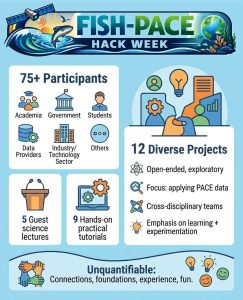 Fish-PACE Hack Week was held January 20–26 and brought together 75+ participants from around the world to explore how NASA’s PACE hyperspectral ocean colour data can be applied to fisheries science and ocean ecosystem questions. Participants developed project ideas with mentors from across NOAA and NASA in the two weeks leading up to the event and pitched them on Day 1. Throughout the week, participants worked in cross-disciplinary teams on their projects and attended lectures and tutorials on ocean colour, PACE data access, and analysis using Python.
The 12 projects reflected the participants diverse interests and included combining IFCB (Imaging FlowCytobot) data to examine phytoplankton community composition and hyperspectral ocean colour relationships; exploring links between MOANA phytoplankton functional groups and whale abundance; assessing water quality in the Gulf of California; exploring mangrove health and investigating fisheries-relevant indicators such as harmful algal bloom risk and habitat conditions. This was a fun and fast-paced week, emphasizing experimentation, collaboration, and capacity-building across the Earth system and fisheries communities. Check out the lectures, tutorials, and projects from the event website: fish-pace.github.io/hackweek-2025/intro.html
News from SOA
China set to launch HY-1F ocean colour satellite in 2–3 years
China will launch its second next-generation ocean colour observation satellite, HY-1F, within the next 2 to 3 years. Since the successful deployment of HY-1E in November 2023, the satellite has been operating stably in orbit for over two years, with its payloads—Second-generation Chinese Ocean Color and Temperature Scanner (COCTS2), Second-generation Coastal Zone Imager (CZI2), and Programmable Medium-Resolution Imaging Spectrometer (PMRIS)—enabling synergistic, multi-resolution observations that have significantly enhanced China’s marine environmental monitoring capabilities. Users can access HY-1E’s products from the China Ocean Satellite Data Service Center.
The HY-1F satellite is currently under development and is designed for an afternoon orbit, intended to replace the operational orbit of its predecessor, HY-1D, with a local time at the ascending node (LTAN) of 13:30 ± 30 minutes. It will carry the same suite of remote sensing payloads as HY-1E (COCTS2, CZI2, and PMRIS) but with key performance upgrades: onboard storage capacity has been substantially increased; and the continuous operational duration of CZI2 and PMRIS has been extended, thereby improving the stability and timeliness of data acquisition.
The HY-1F satellite, expected to launch in 2-3 years, will further strengthen the resilience and technological advancement of China’s ocean colour satellite observation system.
News from SCOR
Join the Ocean 100+ Network
A call for participants is now open to join the Ocean 100+ Network, which is an international initiative endorsed by the UN Ocean Decade and supported by IMBeR. The network aims to unite researchers and stakeholders to co-develop a global, science-based Action Plan for the Ocean.
Interdisciplinary Marine Early Career Network (IMECaN) Survey – Future of ECR Networks
IMBeR’s Interdisciplinary Marine Early Career Network (IMECaN) invites you to take part in a short survey designed to help better understand the backgrounds, interests, communication needs, and engagement of early-career ocean professionals. This survey aims to encourage early-career researchers (ECRs) and ocean professionals in marine sciences to reflect on the future of ocean-related early-career networks – both the near future, the (i.e., beyond the UN Ocean Decade) and the far future.
Community News
Survey on user needs for oceanic profiling lidar
A project focused on a feasibility study for a spaceborne polarized blue-green (486/532 nm) oceanic profiling lidar mission is being coordinated by Cédric Jamet (LOG/ULCO) and involving partners from CNR (Italy), University of Basilicata (Italy), University of Bremen (Germany) and University of Warsaw (Poland). The consortium requests input from the community to understand potential user needs, and determine which parameters and applications are of most interest to the community.
The survey is open here, until 15 March 2026.
Invitation for Chl-a and IOP community round-robin assessment
The ESA Ocean Colour Climate Change Initiative (OC-CCI) will be performing a community round-robin activity to evaluate in-water bio-optical algorithms. The core aim is to identify the best-performing algorithms across the complete ocean colour satellite time series from 1997 to the present to be applied to the next version of the OC-CCI ECV.
An open invitation is extended to contribute by submitting details of published algorithm(s) for consideration and returning results to the evaluation team at CNR and PML for analysis.
See the full invitation, and indicate your interest as soon as possible.
New dataset of marine and estuarine harmful algal bloom records in Indian waters from 1849-2022
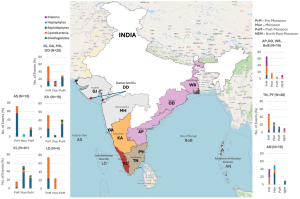 A new dataset listing marine and estuarine harmful algal bloom (HAB) reports in Indian waters from 1849 through October 2022 has been developed and made freely available. The dataset includes information on causative organisms and relevant phytoplankton groups, and provides spatial and temporal distribution patterns of dominant algae by season, year, and geography. The dataset serves multiple purposes to: support publications examining HAB distribution across Indian waters; enable remote sensing users to access historical HAB information for specific regions; and facilitate the development of monitoring methods and temporal-spatial analyses. By establishing a comprehensive baseline of HAB occurrences over 173 years, this dataset is valuable for understanding HAB dynamics, improving remote sensing-based detection methods for target species, and supporting long-term monitoring strategies in Indian coastal regions.
See a full description of the dataset in this 2025 publication.
Other Events
Check for upcoming workshops & conferences, or training events on the IOCCG website.
Ocean Sciences Meeting 2026, 22-27 February, Glasgow, Scotland
 The 2026 Ocean Science Meeting, scheduled for 22-27 February 2026 in Glasgow, Scotland, has several ocean-colour and ocean optics sessions that might be of interest at the meeting. View all sessions here. Relevant topics include: Ocean Technology and Observatories, Ocean Biology and Biogeochemistry, Climate and Ocean Change, Agency Forums, and more.
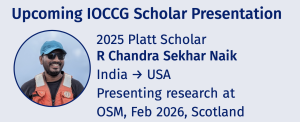 Visit Poster Hall 4 on Wednesday, 25 February and meet the 2025 IOCCG Platt Scholar, Chandra Sekhar Naik R, who will be presenting his work on Satellite & In-situ Evaluation of Phytoplankton Absorption coefficients in the North Indian Ocean: Influence of Water Types and Phytoplankton Size Class.
COSPAR 2026 Call for Abstracts: 1 – 9 August 2026 in Florence, Italy
The 46th Scientific Assembly of the Committee on Space Research (COSPAR) and Associated Events (COSPAR 2026) will be held on 1 – 9 August 2026 in Florence, Italy, hosted by Istituto Nazionale di Astrofisica (INAF). The meeting covers fields of the COSPAR Scientific Commissions (SC), Panels, and Task Groups, including SC A: The Earth’s Surface, Meteorology and Climate, and SC F: Life Sciences as Related to Space, Panel on Capacity Building (PCB), Panel on Establishing a Constellation of Small Satellites (PCSS), and Panel on Early Careers and International Space Societies (PECISS), among others.
The call for abstracts will open on 8 November with a deadline for abstract submission of 13 February 2026. Visit the COSPAR website at cospar-assembly.org/assembly to view the scientific program. Selected papers from the COSPAR 2026 will be published in Advances in Space Research and Life Sciences in Space Research, fully refereed journals with no deadlines, open to all submissions in relevant fields.
For more information, contact the COSPAR Secretariat at cospar@cosparhq.cnes.fr.
Ocean Optics XXVII will be held in Ghent, Belgium
 The 27th edition of the biennial Ocean Optics conference (OO XXVII) will be held in Ghent, Belgium on 13-18 September 2026. The conference brings together the diverse ocean optics community, (oceanographers, limnologists, optical engineers, Earth observation scientists, resource managers, and policy professionals) from across the globe, united by a shared passion for optics in aquatic environments.
Visit their website for more information and to subscribe to the mailing list for direct updates oceanopticsconference.org.
Employment Opportunities
Check for new research and employment opportunities on the IOCCG website: ioccg.org/resources/employment-opportunities.
Research & Employment
Added since the last bulletin:
- Postdoc in Lidar Applications to Ocean Colour, LOG, Wimereux, France
- Postdoctoral Fellow, Brazilian National Institute for Space Research (INPE), Brazil
- Postdoctoral Fellow, Ghent University, Belgium
- PhD Student Positions, Florida State U., USA
- Scientific Researcher, GEOMAR, Kiel, Germany
- Postdoctoral Fellow in Ocean Remote Sensing, U. of Hong Kong
- Researcher, Nansen Environmental and Remote Sensing Center, Bergen, Norway
- Postdoctoral Position in Remote Sensing, IOPAN, Poland
If you would like to include a position on the webpage, please contact Raisha Lovindeer.

 The 6th International Ocean Colour Science (IOCS) meeting was held in Darmstadt, Germany from 1 – 4 December 2025, hosted by EUMETSAT and ESA. All meeting material is available is on the archive webpage.