IOCCG news bulletins include items of interest from the IOCCG, its sponsoring agencies, and the broader ocean colour community. Please let us know if there are any items of interest you would like to see in the next IOCCG news bulletin by contacting Raisha Lovindeer (raisha@ioccg.org). IOCCG is now on Bluesky! Check it out or follow us for more frequent updates.
News from IOCCG
IOCCG Report 22: A Scientific Roadmap of Aquatic Hyperspectral Remote Sensing: Overview of Status, Challenges and Future Perspectives, Version 1.0
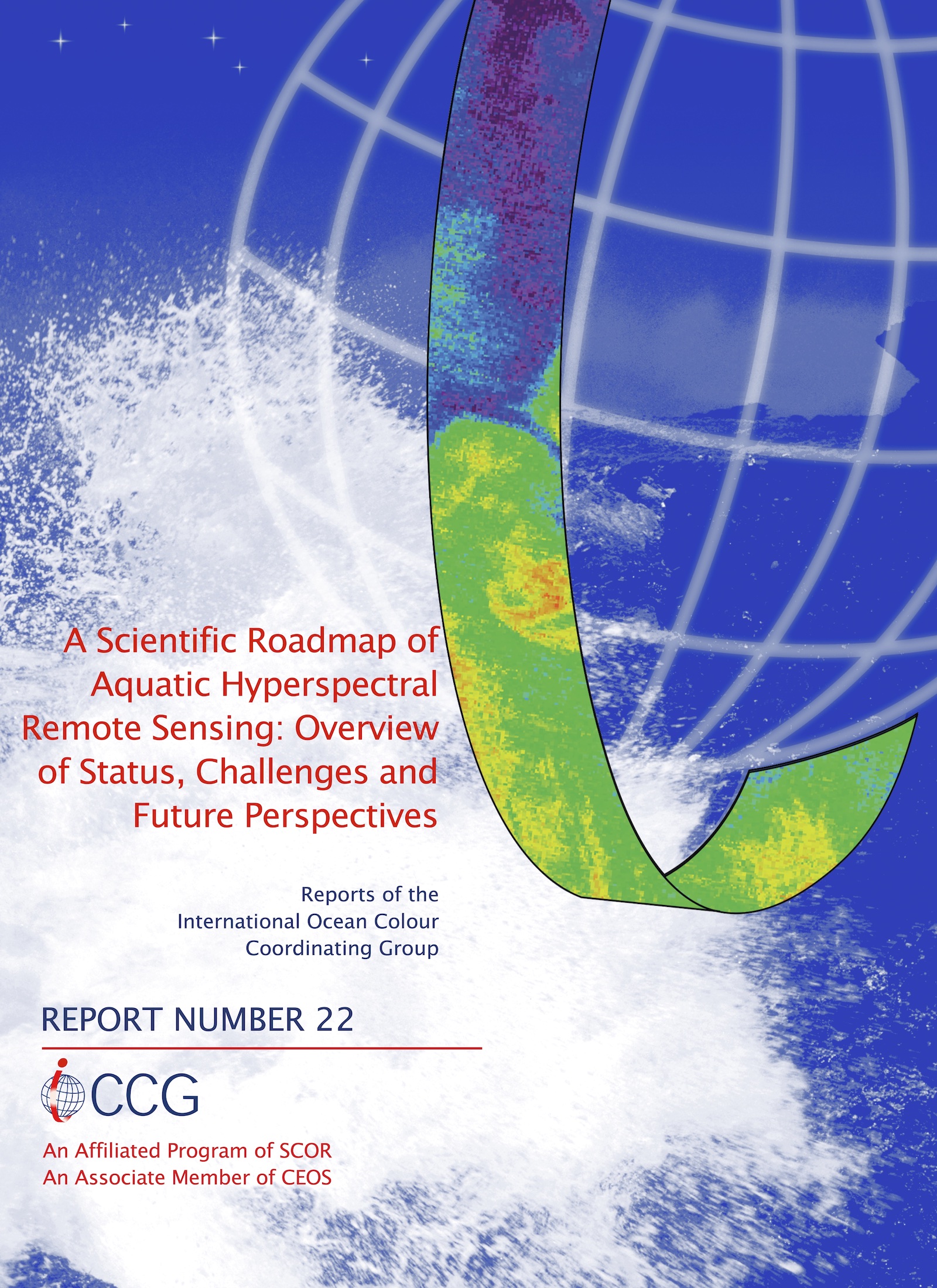 A new IOCCG report (A Scientific Roadmap of Aquatic Hyperspectral Remote Sensing: Overview of Status, Challenges and Future Perspectives, Version 1.0) has been published by the IOCCG Task Force on Aquatic Hyperspectral Remote Sensing. The report defines the benefits of hyperspectral remote sensing techniques relative to retrievals from heritage multispectral sensors, identifies new and emerging science questions, and highlights gaps and challenges that remain to be addressed.
The report is available in digital format only, and freely accessible through either the IOCCG website or the Oceans Best Practice Repository: doi.org/10.25607/OBP-2062
Digital copies of all reports in the IOCCG Report Series can be downloaded directly from the IOCCG website at: ioccg.org/what-we-do/ioccg-publications/ioccg-reports. Reports are no longer being printed. Past reports that are still in print stock can be ordered from the IOCCG website, while stocks last.
IOCCG Summer Lecture Series 2026
A total of 105 applications were received for the 7th IOCCG Summer Lecture Series, being held on 5 – 19 July 2026, hosted by CNR-ISMAR and the Venice International University (VIU) in Venice, Italy. 30 students from 19 countries were selected to attend.
Several distinguished research scientists are lined up to provide lectures and discussions on the fundamentals and future directions in optics, bio-optics and aquatic remote sensing using ocean colour data. Included are in-lab and field practicals with time for data exploration using the Copernicus Sentinel series and the NASA PACE mission. Students will have ample time with lecturers over the two-week period for in-depth discussion of the material and their own scientific research.
27 New Community Recommendations from IOCS-2025
The agencies from the IOCCG thank the science community who came together to review topics of interest at the last International Ocean Colour Science (IOCS) Meeting in Darmstadt, Germany. New recommendations to the aquatic science community utilizing ocean colour data have been added to the IOCS website at iocs.ioccg.org/iocs-recommendations. These recommendations were generated from breakout workshops at IOCS-2025 and are detailed in the Proceedings of the IOCS-2025.
A total of 64 recommendations were generated, 27 of which are geared to you (the science community) on topics including uncertainties, calibration, in situ validation, blended time series, optically complex near-shore waters, and on applications to biodiversity, carbon, and water quality. We invite scientific community members to review and implement, where possible, these new and existing recommendations, and use them as inspiration for future work on these topics. We hope to continue to review and update them as a community at future IOCS meetings, in the breakout sessions. Recommendations geared towards space agencies and the IOCCG are on the agenda for discussion among agency representatives at the up-coming IOCCG Committee Meeting in Tokyo, Japan, this May.
News from KIOST
Reminder: Call for submission to Special Issue on Geostationary Ocean Colour Remote Sensing Data for Improved Understanding of Surface Ocean Biogeochemistry

A reminder that there is an open call for papers for a Special Issue on Geostationary Ocean Colour Remote Sensing Data for Improved Understanding of Surface Ocean Biogeochemistry in the journal of Remote Sensing of Environment (RSE). Papers covering work utilizing geostationary sensors: GOCI, GOCI-II, Himawari 8, ABI, and other geostationary sensors that can be applied to retrieve meaningful information from the oceans (E.g. TEMPO) are welcome. Guest editors are Jongkuk Choi (KIOST), Myung-Sook Park (KIOST), Joseph Salisbury (U. New Hampshire), Hayley Evers-King (EUMETSAT), Cara Wilson (NOAA).
The submission deadline is 31 July 2026. Read more on the journal’s website.
News from NASA
PACE Mission Updates
The PACE mission is pursuing a multi-instrument mission reprocessing. This includes:
- OCI Version 3.0.2 Level-1B and -C
- OCI Version 3.2 Level-2 and -3 aquatic geophysical products
- HARP2 and SPEXone Version 4.0 Level-1B and -C
- HARP2 and SPEXone Version 4.0 Level-2 and -3 geophysical products
Processing is underway at the time of writing. Release notes will be made available in the coming weeks. As always, these data are/will become available via NASA’s Earthdata Search and OB.DAAC.
PACE Events Round-up
- The 6th PACE Applications Workshop was held 11 – 12 March, showcasing PACE’s innovative applications capabilities, new discoveries, and demonstrations to help optimize your PACE data workflows. Recordings and slides are available in the Workshop Archive.
- 14 May 2026: PACE Community of Practice Quarterly Telecon, see the event webpage for the agenda. The meeting link will be sent to the PACE Community listserv, or email Morgaine Mckibben.
Check out the Winter 2026 PACE Community of Practice Newsletter for a round-up of mission news.
News from SCOR
POGO-SCOR Fellowship Programme 2026, applications extended to 13 May 2026
 The Partnership for Observation of the Global Ocean (POGO) and Scientific Committee on Oceanic Research (SCOR) have extended the deadline for the POGO-SCOR Fellowship programme for 2026, which is open for applications until 13 May 2026 (23:59 UTC).
The primary goal of the POGO-SCOR Fellowship Programme is to strengthen sustained ocean observations and their applications, with a focus on training and capacity development to support a global ocean observation framework. Since its launch in 2001, the programme has been highly successful, awarding over 200 fellowships to date.
While there are no specific areas of interest, priority will be given to applications that address any one or more of the following topics:
- Emerging and low-cost technologies for ocean observations
- Physical, biological and biogeochemical sensors on floats and gliders
- Floating litter observations and modelling
- Open and coastal ocean observation, modelling and management
- Data management & time series analysis
- Underwater sound, acoustic observations and modelling
- Optical measurements of living and non-living particles
- Fixed-point time-series observations (e.g. contributing to OceanSITES, OBIS, IODE Ocean Data Portal, WOD and/or other shared data systems)
- Large-scale, operational biological observations including biomolecular and biodiversity (e.g. biological EOVs, CPR, OBON and other programmes)
The fellowship programme is open to early-career scientists, technicians, postgraduate (preferably PhD) students and post-doctoral fellows involved in oceanographic work at centres in developing countries and countries with economies in transition. Applicants must be citizens of developing countries or economies in transition, as defined by the Development Assistance Committee (DAC) of the OECD (see the list of eligible countries). Note that priority will be given to applicants with limited international experience.
The fellowship offers the opportunity to visit leading oceanographic institutions abroad for a short period (1 to 3 months) to gain hands-on experience in oceanographic data collection, analysis, and interpretation. It provides financial support to cover the return airfare from the fellow’s home country to the host institution, and a contribution towards accommodation and subsistence for the period of the visit.
All applications should be made via the application form (link available on the website) by 13 May 2026 (23:59 UTC). Check the Frequently Asked Questions and other supporting documents on the training page before initiating your application documents. If you still have any queries, e-mail info@pogo-ocean.org. Feel free to circulate this announcement to anyone you think might be interested.
Community News
Comprehensive Uncertainty Propagation and Other Advances in New Release of HyperCP
The HyperInSPACE Community Processor (HyperCP) was first developed at NASA and then in collaboration with multiple, international space agencies, academic institutions, and the private sector to process automated and manually acquired, above-water, hyperspectral ocean colour (OC) radiometry data using state-of-the-art methods and protocols for quality assurance, uncertainty estimation/propagation, sky/sunglint correction, convolution to satellite wavebands, and OC product retrieval. Data outputs are formatted for submission to the primary US and EU ocean colour databases (SeaBASS and OCDB) and saved as comprehensive HDF5 records with automated processing reports and figures. The package facilitates rigorous, flexible, and transparent data processing for the OC remote sensing community. Radiometry processed in HyperCP is used for water optical characterization, OC product retrieval algorithm development, and orbital platform validation.
The HyperCP team has worked diligently in the latest release (v1.2.15) to introduce many powerful new features, including class-based and sensor-specific breakdowns in uncertainty budgets delivered with all primary Level-2 products. Classes of radiometers comprise specific makes and models (e.g., Sea-Bird HyperOCR and TriOS RAMSES) for which numerous instruments have been characterized in the laboratory for absolute radiometric calibration and calibration stability, stray light, linearity of response, polarization, and thermal response. These lab measurements, facilitated by the FRM4SOC initiative and work at the University of Tartu (Estonia) and the National Physical Laboratory (UK) and supported by Copernicus and EUMETSAT, have been aggregated to estimate uncertainty within a class without requiring the particular radiometer to be fully characterized. Sensor-specific processing is applied with corrections when the radiometer has been fully characterized and yields lower uncertainties. Breakdowns of uncertainty contributors, including the radiometric characterizations as well as noise, environmental perturbation, waveband convolution, and glint correction model error, are now reported for each measurement made in the field. Knowledge of the impact of individual contributions to the total uncertainty of the ocean colour measurements improves our understanding of the nature of discrepancies found across in situ platforms, and between field data and orbital sensors when matching those datasets for mission validation.
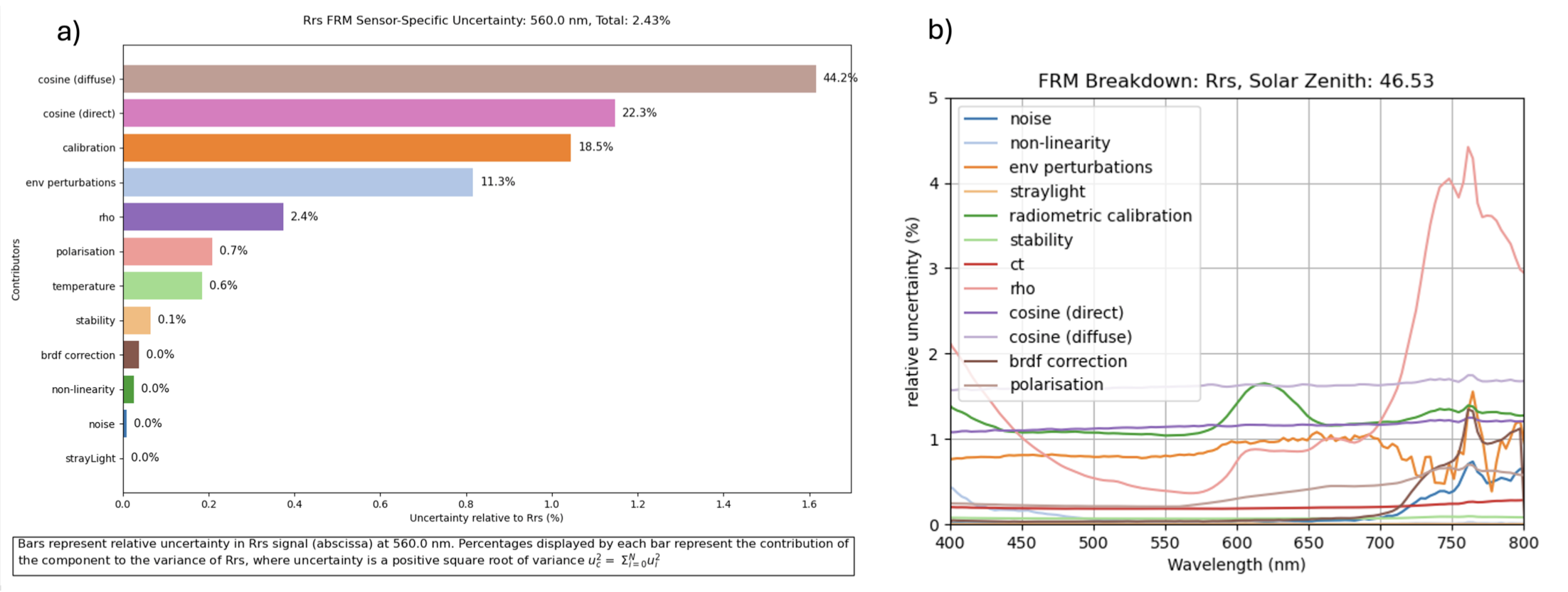
Individual contributors to the total, relative uncertainty in field measurements are now reported with Level-2 products in HyperCP, such as the remote sensing reflectance (Rrs), to help inform ocean colour mission validation. Figures such as the examples here are also provided to the user at individual wavebands (a) and hyperspectrally (b).
In addition to the suite of uncertainty breakdowns and many minor updates, an additional glint correction and bidirectional reflectance distribution function (BRDF) correction from the literature were added to the community processor in this release. The processor now supports autonomous platforms SolarTracker, pySAS, and DALEC, with support for So-Rad well advanced, in addition to manually operated and irradiance-only platforms.
High quality field radiometry is essential for validating orbital OC observatories, and it is critical that they are not only frequent and widespread geographically, capturing diverse optical environments, but also rigorously collected, processed, and quality controlled. HyperCP facilitates capturing these satellite validation datasets from the global OC community by ensuring that data processing and reduction (including quality control and end-to-end uncertainty propagation) is consistent and follows the latest science-driven protocols and developments in the field of in situ, above-water radiometry.
CopernicusLAC Chile Launches New Coastal Monitoring Platform for Latin America and the Caribbean
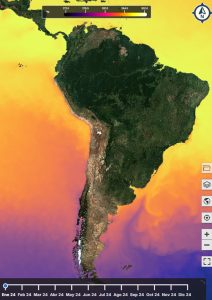 CopernicusLAC Chile presents its new Coastal Monitoring service, an innovative Earth Observation platform designed for the continuous analysis of coastal and ocean systems in Latin America and the Caribbean. This open-source service, designed for both research and operational applications, regionalizes and adapts the Copernicus Marine Services, integrating multi-source satellite data, in situ information, and advanced spatiotemporal analysis methodologies.
The platform provides access to two key variables: Sea Surface Temperature (SST) and Chlorophyll-a (Chl-a). SST is presented as a monthly reference field, free of diurnal variability, based on data from the Sentinel-3, MetOp-B/-C, and NOAA-20/SNPP satellites. Chl-a, an indicator of phytoplankton biomass and primary productivity, is generated from Sentinel-3, MODIS Aqua, and NOAA-20/SNPP data. The service aims to provide consistent, up-to-date, and traceable scientific information to support analysis, planning, coastal management, and decision-making in the public, private, and academic sectors. It also contributes to the monitoring of marine ecosystems and environmental conditions relevant to activities such as fishing and aquaculture.
Access the service at copernicuslac-chile.eu by navigating to the Services section and selecting Coastal Monitoring. Users can choose variables, define areas of interest directly on the map, and download data in .NC or .ZARR formats. Registration on the platform is required to access all features, which offers support through GeoCloud infrastructure and regional dissemination channels. There are plans to incorporate additional variables, such as Ocean Colour products including Sentinel-2 data, and to introduce higher temporal resolution across all variables later this year.
Upcoming Events
Check for upcoming workshops & conferences, or training events on the IOCCG website.
Abstract Deadline Extended: Ocean Optics XXVII

Registration is open for the 27th edition of the Ocean Optics conference (OO XXVII), being held in Ghent, Belgium on 13-18 September 2026. The conference brings together scientists, managers, and policy professionals from across the globe with a shared passion for optics in aquatic environments. Visit the OO XXVII website for more information at oceanopticsconference.org.
IMPORTANT DATES
- EARLY REGISTRATION: Closes May 8, 2026
- ABSTRACT SUBMISSION: Closes May 8, 2026
- Notification of PRESENTATION/POSTER ASSIGNMENTS: by late June 2026
Abstract submission open until 15 May for TREVOR-SAFARI 2026, Kochi, India
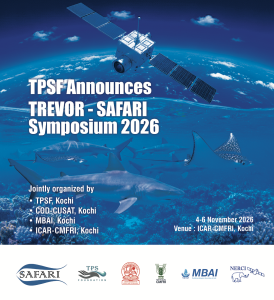 The Trevor Platt Science Foundation (TPSF), together with the Societal Applications in Fisheries and Aquaculture using Remote Sensing Imagery (SAFARI) welcomes abstracts, until 15 May 2026, for TREVOR-SAFARI 2026, a jointly organized international symposium in honor of Professor Trevor Platt FRS FRSC. The event will take place from 4-6 November 2026 at ICAR-Central Marine Fisheries Research Institute (ICAR-CMFRI), Kochi, India, and will be hosted by the Chemical Oceanography Division of the Cochin University of Science and Technology (COD-CUSAT), Kochi, Kerala, India.
TREVOR-SAFARI 2026 follows the highly successful first TREVOR Symposium, held at Plymouth Marine Laboratory in 2023, which brought together 140 participants from 43 countries and was co-sponsored by several international organizations and funding agencies. The 2026 edition will be held jointly with the SAFARI Symposium, building on previous SAFARI meetings hosted in Kochi in 2010 and 2018.
The theme of the symposium is Aquatic ecosystems, including fisheries, in a changing world: Global context and tropical perspectives. The symposium will be preceded by an associated training course for early-career scientists from 27 October to 3 November 2026 at the Indian National Centre for Ocean Information Services (INCOIS), Hyderabad, India, and COD-CUSAT, Kochi, India, including both online lectures and in-person field training. The program will cover a wide range of topics relevant to the aquatic radiometry community, including remote sensing for fisheries, water quality and human health, monsoon dynamics and extreme events, climate resilience and adaptation, and biogeochemical cycles, as well as the integration of indigenous knowledge systems.
Important dates and details about the symposium are available on the TPSF website: trevorfoundation.org/symposium.
Employment Opportunities
Check for new research and employment opportunities on the IOCCG website: ioccg.org/resources/employment-opportunities.
Added since the last bulletin:
- PhD Position, University of Tartu, Estonia
- Postdoctoral Fellow, HBOI-FAU, Florida, USA
- PhD Candidate in spectroscopic ocean colour remote sensing, NTNU, Norway
- Postdoc on BGC-Argo floats, IOW, Rostock, Germany
- Postdoc in Remote sensing of HABs, Uni. of Georgia, Savannah, GA, USA
- Research Fellow, CNR-ISMAR, Trieste, Italy.
- Project Officer – Earth Observation Expert, EC-JRC, Italy.
- Earth Observation Project Manager, Kongsberg Satellite Services (KSAT), Tromsø, Norway
If you would like to include a position on the webpage, please contact Raisha Lovindeer.

 The 6th International Ocean Colour Science (IOCS) meeting was held in Darmstadt, Germany from 1 – 4 December 2025, hosted by EUMETSAT and ESA. All meeting material is available is on the archive webpage.